
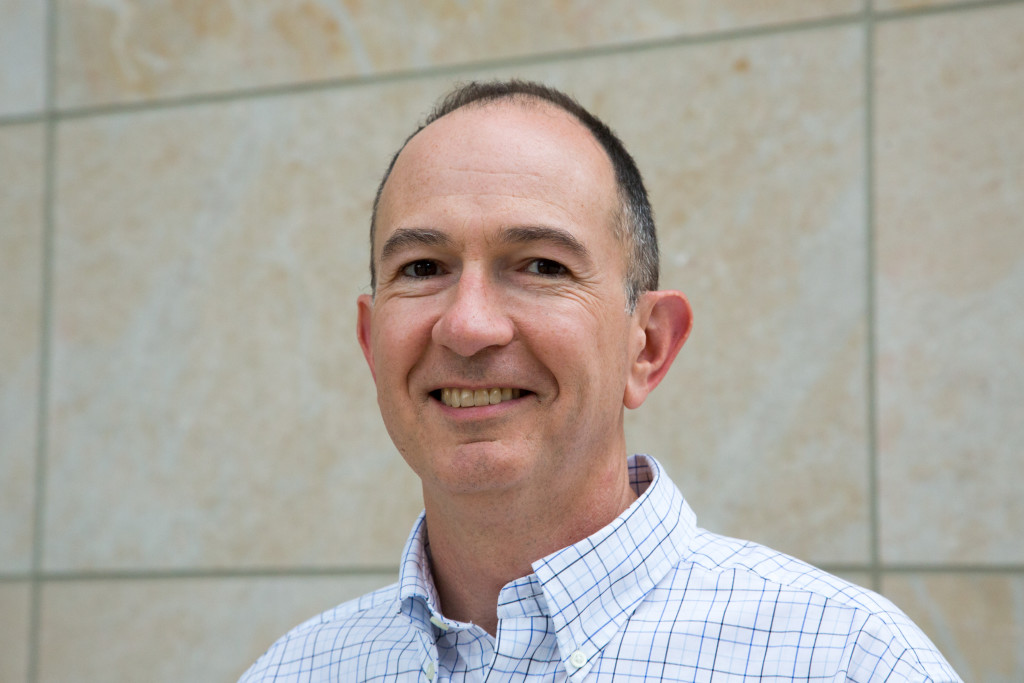
A few weeks ago, I got a note from Kelly Brieger, an old friend in the San Francisco Bay Area who has done extensive communications and public relations work for the Palo Alto Research Center, the famed Xerox-owned R&D lab. Kelly’s daughter Alexandra Brieger writes the M-A Bear News at Menlo-Atherton High School, where she is a sophomore, and Alexandra was wondering whether I’d be willing to work with her on an Q&A-style article about my work here at MIT.
I gladly agreed, and the finished piece was published this week. With permission, we’re republishing the original interview here. I used Alexandra’s excellent questions to give a bit of personal history about my route into science and technology journalism, and to share some advice for ambitious young people about how they can get started in their own careers.
Many thanks to Alex, her mom, and the M-A Bear News for the opportunity.
1. What’s been the hardest thing you’ve had to overcome with respect to your career?
I was lucky enough to have what you might call mid-life crisis when I was really young, about 19 or 20. I fell in love with physics and biology and astronomy as a high school student, and when I got to college I thought I wanted to be a scientist – specifically, an astronomer or an astrophysicist, like my hero Carl Sagan. But around my sophomore year I realized that I wasn’t good enough at math to go very far as a scientist. I was getting C’s in classes like physics and linear algebra, which is never a good sign.
Some other things happened around that same time, which I’ll say more about in a minute. But the result was that I had to decide pretty quickly what my future was going to be about. Could I be a journalist instead?
Before college, I’d never thought of myself as a writer – my high school didn’t even have a school newspaper. But I was having fun reporting and editing for my college’s weekly paper, and I liked having the chance to explain things to people through my articles. So I talked myself into giving up my dream, going with something new that felt right, and taking risk on a future that I hadn’t considered before. It turned out to be a good decision. I would have made a lousy astronomer.
2. What kind of education did you have? Did you always know you wanted to be in the field of journalism?
I went to a small-town high school in Michigan, then went very far away (to Cambridge, MA) for college and graduate school. I got a B.A. from Harvard in history and science and a PhD from MIT in the history and social study of science and technology. By the time I got to MIT I was sure I wanted to be a journalist and I designed my graduate work around that goal.
3. What is your current job at MIT and what do you enjoy most about it?
Since July I’ve been the acting director of the Knight Science Journalism program, which brings a dozen experienced science and technology writers to MIT each year for nine months of course work, seminars, and immersion in the culture of the Institute. It’s a chance for them to master new topic areas in science or engineering, learn new storytelling skills, meet new sources, and recharge their batteries as journalists.
Starting in 2015, I’ll be turning to a new project for the Knight program designed to boost public engagement in technology and science. We want to understand better how ordinary people learn about science and technology issues and how journalists and other communicators can help equip them to be more involved in these issues as citizens and consumers.
What I’m enjoying most this year is the chance to work with the current batch of Knight Fellows. They’re a really fun, smart, good-humored bunch, and they’re making this year a joy so far. In the bigger picture I’m really excited about the opportunity to help MIT have a bigger impact in an important area of scholarship, and it’s fun to be back at an institution I love, and where I’ve spent so many fun and productive years.
4. What would you tell my generation about starting out their own careers (not necessarily journalism, but anyone who wants to have an ambitious career)?
I’d say, first, don’t skip college, even though there are successful people like Peter Thiel who say college is a waste of time. That might be accurate for a handful of young entrepreneurs, particularly if they have a business idea that’s so timely and urgent that it might be irrelevant four years from now. But for the vast majority of people, it’s just not true. You will land a better job with a higher income if you have a college degree.
The flip side, though, is that entrepreneurship is good, and everyone who wants to be successful in our changing economy needs to think in a more entrepreneurial or executive way about their own career. No one is going to hand you knowledge or opportunities on a platter. You have to decide what you believe in and what feels most rewarding, and then work to line up the resources to make it happen. That may involve some risks and costs. At the very least, you’ll have to pass up some opportunities in order to focus on others. That’s okay. Anything worthwhile involves some risk.
And don’t forget that you have a community, and it’s okay to rely on your family, friends, and teachers for help. They want to see you succeed and they often have experience in areas where you don’t. And the networks of connections you build now and in college and maybe graduate school will serve you throughout your life. Of the six staff jobs I’ve had since finishing graduate school, I got three of them with the help of people in my network. (The other three came out of the blue or resulted from “cold calls” where I applied without knowing anybody.)
5. Given your passion for technology and science, what made you want to write stories about them as opposed to going into the field of technology or science?
When I got to college, I thought I did want to go into science. Then several things happened, all around the same time.
As I mentioned earlier, I started getting C’s in advanced math classes like linear algebra. I started spending all my time at the weekly campus newspaper, the Harvard Independent, and fell in love with journalism. I had a work-study job as a computer system administrator at the Harvard-Smithsonian Center for Astrophysics, which gave me an inside look at the lives of real astronomers; they do an awful lot of programming and data analysis, which didn’t fit with my romantic preconceptions of science.
The Challenger space shuttle accident also happened around this time, and that was traumatic for me. It woke me up to the fact that American technology wasn’t perfect and that space travel and science in general are risky enterprises – all of which got me thinking in a more critical way about science and technology.
Finally, I started taking classes in Harvard’s History of Science department. I realized that what I had really loved about Carl Sagan’s work, especially in the original Cosmos series, was the way he told stories that weave together science and history. I figured that the best way to stay close to all these things I loved – science, technology, journalism, and history – was to pick one (journalism) but get trained as a historian of science and technology first.
6. Can you describe the differences or similarities between working at a university, a company, and a publication?
It’s really hard to answer that question. All of the jobs I’ve had, before my current job at MIT, have been at publications. One of the publications was run by a large non-profit organization, one was run by a government agency, one was run by a university, and two were run by startups. So it’s hard to separate out these experiences cleanly.
But I think it’s fair to say that companies, especially startups, have to look for immediate, short-term successes and have to account for every dollar they spend and earn, which means employees always have to think about how their work is creating tangible value. When I was at Xconomy, I always wanted to write great stories about innovation and organize compelling events that would keep people interested, but it was never far from my mind that we had real customers in the form of advertisers and underwriters and people who bought tickets to the events. At universities, or inside government, these kinds of pressures are a little more distant and you have more room to pursue work that might not have an immediate payoff. The advantage is that you can think a little more broadly. The down side is that there’s less pressure to be relevant and to create things that people will actually value.
The main similarity between universities, companies, and publications is that they’re all human organizations. The most important requirement for getting things done and growing in your career is understanding how to work with other people and figuring out how your skills and interests fit with the needs and hopes of the organization. If you don’t like working with people, or if there’s a mismatch between what you love to do and what the organization needs, it’s not going to work out in the long run.
7. How did you start your career and what did you have to do in order to get where you wanted to be?
I talked about how I settled on science and technology journalism as a career in my answer to Question 5 above. I didn’t really need to go to graduate school and get a PhD in history in order to be a journalist. But by the time I was done with college, I’d developed a deep interest in history of science and history of technology, and an intriguing new graduate program in Science, Technology, and Society (STS) was getting started at MIT right at that time. So it seemed like a worthwhile detour.
After that, moving ahead was mostly a matter of gaining the experiences and credentials I needed to make me a decent candidate for whatever the next job might be. In journalism, that boils down to publishing lots of articles and building up a portfolio of clips. I started writing magazine articles for MIT’s Technology Review magazine while I was still in graduate school, so by the time I finished I had enough clips to be able to apply for a job at Science magazine. After several years at Science, and a couple of years in Silicon Valley (at NASA and an e-book startup called NuvoMedia), I had enough material and enough new skills to apply for a full-time job at Technology Review. And so forth. It’s also important to learn how to present yourself: you want to be seen by potential employers as innovative and full of ideas, but also as a team player who will put the organization first.
8. Looking back, would you have wanted to do anything different with your education or your career?
Sometimes I worry that I haven’t been ambitious or adventurous enough. I’ve never published a book, for instance, though I’ve got enough material sitting around to write several of them. There have been times when I’ve put family, relationships, or even my dog above my work. But everyone has to do that sometimes, and I don’t think of it as a failing.
Also, I’m a bit of an introvert, and it’s easy for me to fall into a routine and stay there for too long. So if I got a “do-over” I’d probably try to force myself to be a little more extroverted, to meet more people, and to travel more. If there’s one thing that’s always worth the time and the money, it’s treating yourself to new experiences.

Leave a Reply